Why Learning How to Avoid Fraud Could Save Your Life Savings
Learning how to avoid fraud is critical because scammers target everyone, with tactics growing more sophisticated each year. In just one year, 1 in 17 adults fell victim to fraud. This is especially true for grieving families dealing with complex estate matters.
Quick Answer: Essential Steps to Avoid Fraud
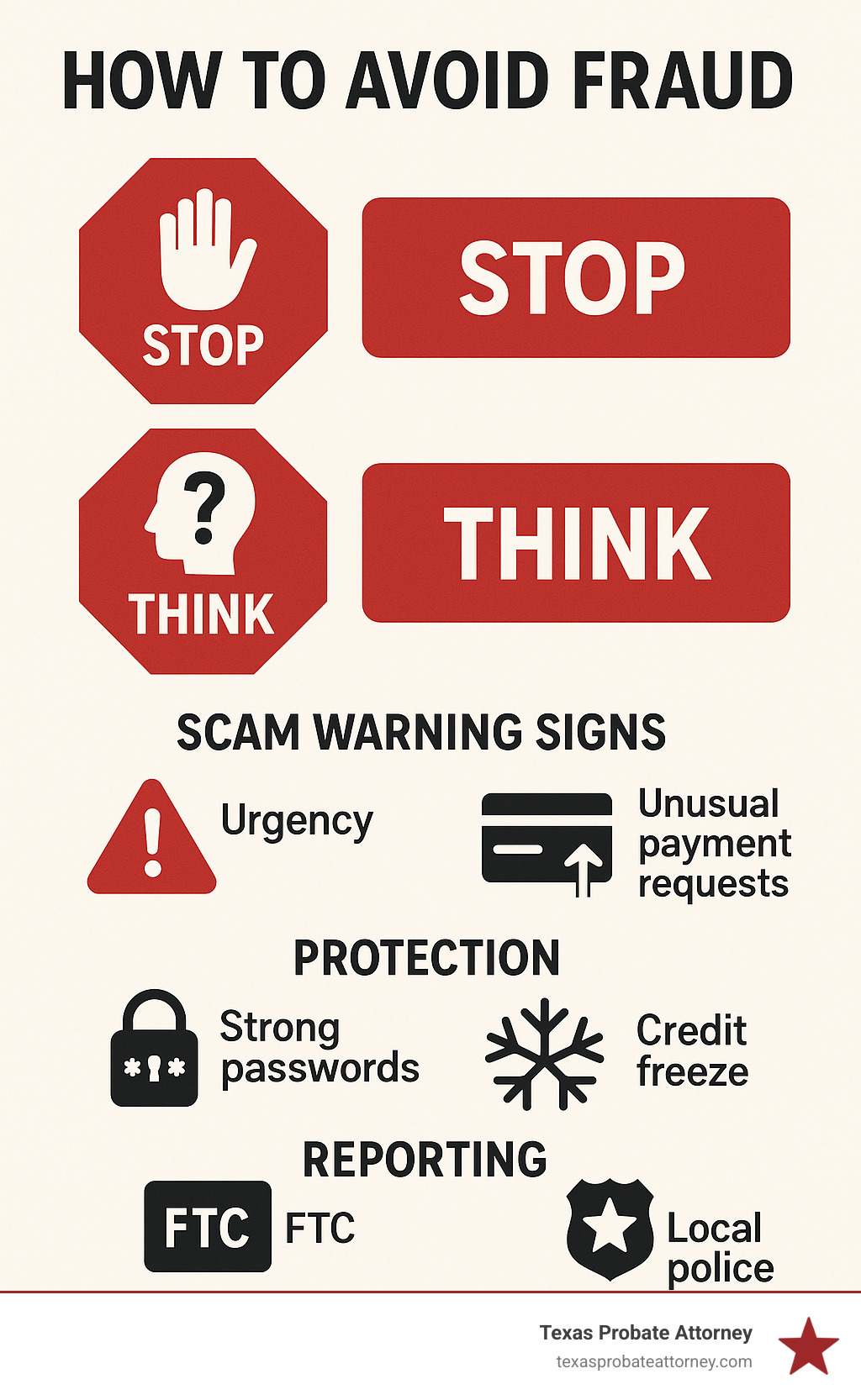
- Stop – Don’t act immediately on unexpected requests for money or information.
- Think – Ask yourself if the request could be a scam.
- Check – Verify independently before taking any action.
- Protect – Use strong passwords, freeze your credit, and never give personal info to unsolicited callers.
- Report – Contact authorities immediately if you suspect fraud.
Fraudsters prey on anyone they can trick or pressure. When you’re managing a loved one’s estate, you can be more vulnerable to scams that exploit your emotions or unfamiliarity with legal processes.
The good news is that most fraud is preventable if you know the warning signs. Scammers create urgency, fear, or confusion to bypass your skepticism. They might impersonate officials or pressure you to act “immediately” to avoid trouble.
What every scammer fears is an informed victim who takes time to verify claims. This guide provides strategies to help you recognize red flags, protect your information, and respond effectively to suspicious activity.
Essential How to avoid fraud terms:
Recognize the Enemy: Common Scams and Their Red Flags

To master how to avoid fraud, you must understand common scam tactics. Crooks use clever schemes combining new technology with old tricks. Understanding how they work is the first step to protecting your money.
Here are some of the most common types of fraud:
- Phishing and Smishing: Scammers pose as legitimate entities (banks, government agencies) via email (phishing) or text (smishing) to trick you into revealing personal information or clicking malicious links.
- Identity Theft: Someone steals your personal information (Social Security number, credit card details) to commit fraud, such as opening new accounts or making unauthorized purchases.
- Romance Scams: Scammers create fake online profiles to build emotional relationships, then invent stories (medical emergencies, business failures) to solicit money.
- Imposter Scams: Fraudsters impersonate someone you trust (a family member, a charity, tech support) to pressure you into sending money or giving up personal information.
- Government Impersonation Scams: Scammers pretend to be from the IRS, Social Security Administration, or police, threatening arrest or legal action unless you pay immediately. Legitimate agencies will never threaten you or demand payment by gift card or wire transfer.
- Tech Support Scams: A pop-up or cold call claims your computer has a virus. The scammer then tries to gain remote access or sell you unnecessary “repairs.”
- Grandparent Scams: A fraudster calls pretending to be a grandchild in urgent trouble (e.g., arrested, in an accident) who needs money immediately and secretly.
- Investment Fraud: These scams promise high returns with little risk, from fake opportunities to Ponzi schemes. A common type is “pig butchering,” where scammers build trust before convincing victims to invest in fake crypto platforms.
- Elder Financial Exploitation: A broad category targeting older adults. It includes the scams above, plus abuse by fiduciaries (like guardians or those with power of attorney) who misuse their position.
The key warning signs of a potential scam include:
- Urgency: Demanding immediate action to create panic and bypass your critical thinking.
- Threats: Threatening legal action, arrest, or public embarrassment if you don’t comply.
- Secrecy: Insisting you keep the request a secret from family or trusted advisors.
- Unusual Payment Requests: Demanding payment via gift cards, wire transfers, cryptocurrency, or reloadable debit cards. Legitimate entities rarely use these methods.
- “Too Good to Be True” Offers: Promising guaranteed high returns or a huge prize for a contest you never entered. If it sounds too good to be true, it is.
Learn about investment fraud from the SEC
Fortify Your Defenses: Essential Steps for Online and Offline Security
Protecting yourself from fraud means building strong digital and real-world defenses to make it harder for scammers to access your information and money.
Secure Your Digital Life
Your online life presents many opportunities for fraudsters. Protecting your devices and accounts is paramount.
- Strong, Unique Passwords: Use long (at least 8-digit alpha-numeric), complex passwords with a mix of cases, numbers, and symbols. Use a unique password for each account and update them regularly.
- Two-Factor Authentication (2FA) / Multi-Factor Authentication (MFA): Enable 2FA for an extra security layer. It requires a second verification step (like a code sent to your phone), preventing access even if a scammer has your password. Use biometrics like fingerprint or facial recognition on mobile apps when available.
- Software and Operating System Updates: Keep all software, browsers, and operating systems updated. Updates often contain critical security patches that protect against known vulnerabilities.
- Public Wi-Fi Risks: Be cautious on public Wi-Fi networks, which are often unsecured. Avoid accessing sensitive accounts (like banking) or use a Virtual Private Network (VPN) for protection.
- Social Media Privacy: Limit the personal information you share online, such as your phone number, address, or birthday. Avoid posting your location in real-time; wait until you return from vacation to post photos.
Review CISA guidance on Choosing and Protecting Passwords
The Importance of Digital Estate Planning
Safeguard Your Financial Information
Protecting your money requires vigilance with both digital accounts and physical documents.
- Credit Freezes vs. Fraud Alerts: These are two powerful tools to protect your credit.
- Fraud Alert: Asks lenders to verify your identity before opening new credit. It’s free and lasts for one year.
- Credit Freeze (Security Freeze): A stronger measure that restricts all access to your credit file until you unfreeze it, blocking both unauthorized and legitimate credit checks. It is also free.
| Feature | Fraud Alert | Credit Freeze (Security Freeze) |
|---|---|---|
| Purpose | Alerts lenders to verify identity for new credit | Blocks all access to credit file |
| Duration | 1 year (renewable) | Indefinite (until you lift it) |
| Impact on Credit | Allows new credit applications with verification | Prevents ALL new credit applications (even yours) |
| Cost | Free | Free |
| When to Use | If you suspect identity theft, but still need credit | After a data breach, or if not seeking new credit |
- Electronic Statements: Opt for e-statements to reduce the risk of mail theft.
- Shredding Documents: Use a cross-cut shredder to destroy sensitive documents like bank statements and credit card offers before disposal.
- Credit Card vs. Debit Card Protection: Use credit cards for purchases when possible, as they offer stronger fraud protection and limit your liability. Debit card fraud directly depletes your bank account. Mobile payment options like Apple Pay or Google Pay add another layer of security by tokenizing your card number.
More on protecting your assets
Master the Art of How to Avoid Fraud in Daily Interactions
Scammers persistently try to reach you by phone, email, and text. Knowing how to handle these everyday interactions is crucial for fraud prevention.
How to avoid fraud on the phone

Scammers use automated robocalls and Caller ID Spoofing to trick you. Spoofing makes a call look like it’s from a local number or a trusted organization. Don’t trust your caller ID.
If you get a robocall from an unknown number, hang up. Don’t press any numbers, as this just confirms your number is active and invites more calls.
For any suspicious call that seems urgent or official, follow this rule: Verifying Numbers is key. Hang up and call the organization back using a number from their official website or a statement. Never use a number the caller provides.
Legitimate companies and government agencies will Never Give Info in a threatening way or demand payment via gift cards or wire transfers. They won’t call unexpectedly to ask for your Social Security number or bank details. If a caller demands money or information with threats, hang up.
You can also add your number to the National Do Not Call Registry to reduce unwanted calls.
Add your number to the Do Not Call Registry
How to avoid fraud via email and text
Fraudsters use phishing (email) and smishing (text) to steal your information.
Be wary of clicking Phishing Links in unexpected messages. Hover your mouse over links to see the actual web address and check for misspellings or odd domains. For example, support@amaz0n.com is not Amazon.
Always Check Sender Address carefully for subtle changes that mimic real ones. If you don’t know the sender, don’t open attachments. Unsolicited Attachments can contain malware.
Smishing uses text messages to get you to click a link to claim a prize or fix an urgent problem. These are almost always scams.
Look for Spelling and Grammar Errors. Poor spelling and awkward phrasing are common signs of scam messages.
Watch the FDIC explain phishing scams
Be Wary of These Payment Methods
Scammers prefer untraceable payment methods that are difficult to reverse. A request for these is a major red flag.
- Wire Transfers: Services like Western Union or MoneyGram are like sending cash. Once picked up, the money is gone.
- Gift Cards: No legitimate company or government agency will ever ask for payment with gift cards (like iTunes or Google Play). This is always a scam.
- Cryptocurrency: Scammers push for crypto payments because they are irreversible and hard to trace, especially in investment scams.
- Reloadable Cards: Cards like MoneyPak or Reloadit act like cash and are untraceable once the funds are loaded.
- Peer-to-peer apps: Apps like Zelle or Venmo are great for friends but risky with strangers, as payments are instant and hard to reverse.
Why scammers request them: These methods are fast, anonymous, and irreversible. Once you send money, it’s likely gone for good. Use secure payment methods with fraud protection, like credit cards, whenever possible.
Special Focus: Protecting Vulnerable Loved Ones from Financial Exploitation

Financial exploitation of vulnerable loved ones, especially older adults, is a cruel and common form of fraud. At Texas Probate Attorney, we see its devastating effects in our probate and estate work, as millions of seniors are victimized annually.
Elder fraud refers to any scam or abuse targeting seniors. It can come from strangers or, sadly, from a trusted person like a family member or caregiver.
Undue influence is when someone uses their power over another to coerce them into making financial decisions against their own interests, such as changing a will or giving away money.
A fiduciary duty is the legal and ethical obligation of a trusted person (like a trustee, executor, or someone with Power of Attorney) to act in your best interest. Abusing this position is a serious breach of trust, and we often help victims recover lost assets.
Look out for these warning signs of abuse or exploitation:
- Isolation: A new “friend” or caregiver attempts to isolate your loved one from family and friends.
- Sudden financial changes: Look for unusual bank withdrawals, new joint accounts, or unexpected changes to their will or beneficiaries.
- New “best friend”: A new person, often much younger, becomes involved in their life and finances very quickly.
- Fear or anxiety: Your loved one seems fearful or secretive when asked about their money or a new person in their life.
- Unusual bills or debts: Unpaid bills appear despite sufficient funds, or new debts arise that they can’t explain.
- Lack of access to funds: They complain they can’t get to their own money or property.
- Changes in living conditions: A noticeable decline in their home’s condition or personal care, despite having the money for it.
If you notice these signs, act quickly. Cases of financial exploitation can be complex and often require legal help. Being watchful is the first step in protecting your loved ones.
Learn about Power of Attorney Abuse
Understand Texas Guardianship Litigation
What to Do If You’re a Victim: A Step-by-Step Recovery Guide
Even with precautions, anyone can become a victim of clever scammers. It’s not your fault. Acting quickly is key to limiting the damage and starting your recovery.
First, act quickly. Every second counts. While getting money back can be difficult, prompt action increases your chances and limits further losses.
Immediately contact your banks and financial institutions. Call your bank and credit card companies to freeze accounts, cancel cards, and dispute unauthorized transactions.
Next, protect your identity. Initiate a fraud alert or a credit freeze with the three major credit bureaus (Experian, Equifax, TransUnion). A fraud alert warns lenders to verify your identity, while a credit freeze blocks access to your credit file entirely, preventing new accounts from being opened.
Secure your digital life by immediately changing passwords for all affected and important online accounts. Enable two-factor authentication (2FA) wherever possible.
Finally, it’s crucial to report to authorities. Reporting helps law enforcement track criminals and protects others.
Where to Report Fraud and Get Help
Knowing where to turn for help is a key part of recovery:
- Federal Trade Commission (FTC): Report most types of fraud to the FTC. They collect complaints about scams and identity theft, which helps law enforcement investigations.
Report fraud to the FTC - FBI Internet Crime Complaint Center (IC3): If the scam involved the internet, file a complaint with the FBI’s IC3.
File a complaint with the FBI’s IC3 - Local Police: Report the crime to your local police, especially if you lost money. A police report is helpful for insurance claims and disputes.
- Adult Protective Services (APS): If the victim is an older adult or an adult with a disability, contact your local APS agency.
- Social Security Administration (SSA): If your Social Security number was compromised, notify the SSA.
- Your Financial Institutions: Always report suspicious activity directly to the bank, credit card company, or investment firm involved.
Being scammed is upsetting. Don’t suffer in silence. Reach out to trusted friends, family, or a counselor for emotional support.
Frequently Asked Questions about How to Avoid Fraud
It’s natural to have questions about protecting yourself from scams. Here are answers to some common concerns about how to avoid fraud.
What is the single most important thing I can do to avoid fraud?
The most important rule is to be skeptical of unexpected requests and use the “Stop, Think, Check” method.
Stop: When pressured to act immediately, pause. Scammers create urgency to prevent you from thinking clearly.
Think: Ask yourself if the request makes sense. Is this how a legitimate organization would contact you? Trust your gut.
Check: Independently verify the situation. Look up the official phone number for the company or agency and call them directly. Never use contact information provided by the potential scammer. This simple verification step can stop most scams.
This proactive approach of skepticism and verification is your strongest defense.
Can I get my money back if I’m scammed?
It’s often very difficult. Recovery depends on the payment method and how quickly you act. If you paid with a credit card, you have strong consumer protections and may be able to dispute the charge. However, if you used wire transfers, gift cards, or cryptocurrency, it’s extremely hard to get your money back because these methods are nearly impossible to trace or reverse.
The faster you report the scam to your bank and authorities, the better your chances of limiting the damage. Unfortunately, there’s no guarantee.
Are certain people more at risk for fraud?
Anyone can be a victim, as scammers target everyone. However, older adults are often disproportionately affected. This is not due to a lack of intelligence but a combination of factors scammers exploit:
- Isolation: Loneliness can make someone more receptive to a scammer pretending to be a friend.
- Trusting Nature: Some may be more trusting of those who sound official or friendly.
- Perceived Wealth: Scammers assume seniors have accumulated savings.
- Digital Literacy Gaps: Less familiarity with online security can increase vulnerability to digital scams.
- Vulnerability to Undue Influence: Some may be more susceptible to manipulation, especially from those in a position of trust.
Regardless of age, staying vigilant and informed is the best defense.
Conclusion
Mastering how to avoid fraud requires developing a healthy skepticism. Scammers constantly evolve their tactics, but by staying informed about the red flags, you can stay one step ahead.
Always use the “Stop, Think, Check” method for any suspicious message or call. Treat your personal and financial information like the treasure it is. If a situation feels off, trust your gut and verify it before acting.
Sometimes, fraud becomes especially complex, particularly when it involves wills, trusts, or fiduciaries. When manipulation or theft threatens an estate, legal guidance is often necessary.
Our firm, Texas Probate Attorneys, is here in Texas, focusing on probate, trust, and estate planning litigation. With over 40 years of combined experience, we provide personalized legal help, fighting for quick resolutions to protect your assets. Whether you’re in Houston, Fort Worth, or Austin, we are ready to help you steer complex financial disputes.
Contact a Texas Fiduciary Litigation Attorney for help with complex financial disputes